
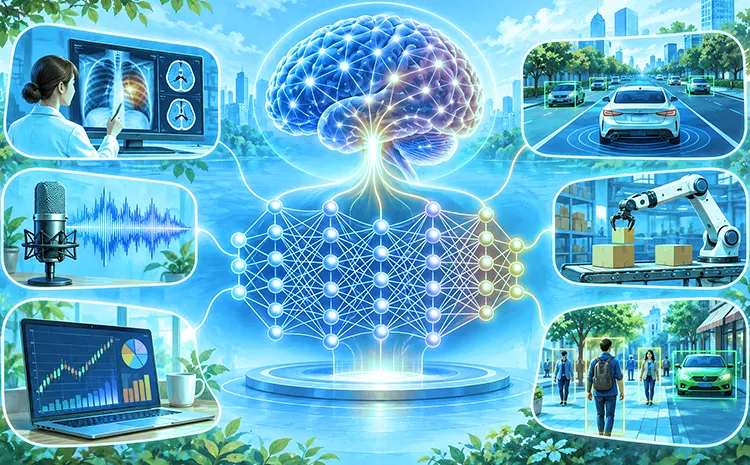
Deep learning is a type of machine learning that uses artificial neural networks to learn from large amounts of data. These networks are made up of many layers that work together to understand information, find patterns, and use that knowledge to make predictions or decisions. It’s kind of like how our brains work, and it helps computers do tough tasks like recognizing pictures, understanding what we say, and looking at data to find important information. This technology is compelling and is being used in many different areas, from self-driving cars to medical diagnosis. By using deep learning, computers can get better and better at doing these tasks, and it’s helping to make many things possible that weren’t before.
What Are the Requirements for Deep Learning?
The earliest artificial intelligences (AIs) were able to learn very quickly to solve mathematically comprehensible problems. Mathematical rules are unambiguously definable and therefore correspondingly easy to learn. AIs were able to process tasks that were sometimes impossible for humans quickly and easily.
However, tasks that humans can handle intuitively, such as recognizing faces, identifying voices , or understanding jokes, have always posed a significantly greater challenge for computers. Machines must learn to evaluate the sensor-acquired input data and respond with appropriate output. We humans categorize sounds and sound sequences, structures, shapes, and colors in relation to what we have already learned, and in this way, we are able to understand the context of the input and react accordingly.
This ability to understand and categorize more complex relationships is what we call “learning.” And that’s precisely where machine learning comes in : machine learning creates adaptable algorithms that evaluate data and patterns, thereby generating knowledge independently. Deep learning goes a step further: this machine learning method automatically organizes what it has learned. Algorithms are centrally organized into layers that function like neurons.
How Do Artificial Neurons and Neural Networks Work in Deep Learning?
Deep learning uses artificial neural networks for knowledge generation and processing. These networks, in their basic structure, already mimic nervous system structures, and in particular, human brain structures. In our brains, neurons are interconnected as a network. Computer systems are similar in this respect.
The first layer, the input layer, of both natural and artificial neural networks processes the raw data input. Here, input neurons capture the individual pixels of an image or the individual tones of a sound frequency and systematize them. In deep learning, the raw data is then passed on to the subsequent layers for more in-depth analysis.
The neurons on these additional layers, the so-called hidden layers, categorize the raw data in relation to known patterns. These are called intermediate neurons. Depending on the neural network, countless layers evaluate the data. Similar to biological neural networks, artificial network structures constantly rewire themselves during the learning process and continuously adapt to the evaluations.
Deep learning enables AI to perform more in-depth analyses and make corresponding decisions. In the output layer, output neurons encode the decision into a corresponding, understandable expression and output it.
The sensory input we humans perceive is specifically sensory impressions. These networks are formally referred to as convolutional neural networks.
Machine Learning vs. Deep Learning: What Is the Difference?
Comprehensive data analysis generates knowledge that can be used to classify and evaluate further potential data. Large datasets are not only analyzed themselves but also form a basis for analyzing future datasets. The larger the datasets, the more suitable deep learning analysis becomes. However, a fundamental prerequisite in every case is that patterns and models can be derived from the data.
Since deep learning is a subfield of machine learning, and almost all modern machine learning is also deep learning, the two terms cannot be clearly distinguished. However, they can be clearly differentiated: In machine learning, humans are directly involved in the evaluation of data, while in deep learning, the machine handles the evaluation completely on its own. Humans only provide the data and monitor the documentation of all processes. Applications based on deep learning are suitable if you are using high-performance GPUs (graphics processing units) and want to analyze large and constantly growing datasets.
What Are the Main Applications of Deep Learning?
The most well-known applications of deep learning today are facial, speech, and object recognition, including for so-called deepfaking. AI is also already being used to predict natural disasters such as earthquakes. It can be used to detect diseases or pathological abnormalities such as cancer cells at an early stage. Furthermore, it enables the analysis of customer behavior and the independent development and improvement of programs.
Neural networks are also used, for example, in the upscaling and recoloring of photo and video material. A suitably trained AI can, after viewing and analyzing a large number of videos, independently convert ancient black-and-white recordings into high-resolution, smooth Ultra HD quality and display them in color. The more data the AI analyzes, the easier it becomes for it to bring other videos up to current technological standards.
How Is Deep Learning Used in Business?
AI now enables concrete predictions about behavior, transactions, and performance levels in various contexts. The accuracy of these analyses and predictions is already truly astonishing. The possibilities offered by advances in artificial intelligence, and especially what will become possible in the future, are almost impossible to fully grasp.
However, it is already becoming clear that in the future, it will be essential to integrate AI centrally into more and more processes and to rely on self-learning software. In current practice, various deep learning frameworks are used to create corresponding software solutions. These frameworks allow for the development of machine learning applications or the adaptation of existing applications.